
Choosing a road bike comes down to where you want to ride, how fast you want to go, and how much comfort you need. We say that a good bike is like a good life partner (or spouse); you have to invest time and money to find a good one, for a good, long-term relationship. So do not rush to buy the very first bike you see, or the one that everyone is talking about.
In this article, we briefly give you a breakdown of the five main categories of road bikes and the technology that drives them. We have really “simplified” the descriptions for a layman, but once you find one that sits well with you, you can take time to do a little more research to best answer your questions.
1. Choose Your Riding Style
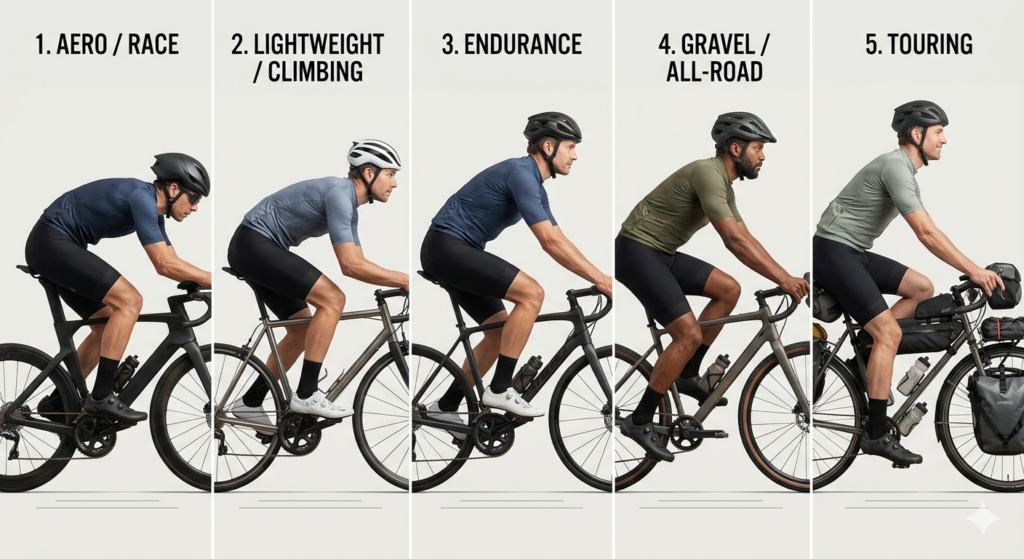
- Aero Bikes: Built for flat-out speed. Every frame tube is shaped like an airplane wing to cut through the wind. They feature an aggressive, low riding position. Best for racers and riders who love chasing high average speeds.
- Lightweight / Climbing Bikes: Engineered to be as light and stiff as possible. They feature traditional round tubes and excel at snappy acceleration and conquering steep hills.
- Endurance Bikes: Built for long days in the saddle. They feature an upright, relaxed riding position, frame tech that absorbs road vibration, and slightly wider tires. Perfect for charity rides, grand fondos, and casual fitness.
- Gravel / All-Road Bikes: The ultimate chameleons. They look like road bikes but have rugged frames, heavy-duty disc brakes, and wide, knobby tires. If you want to transition seamlessly from smooth pavement to dirt paths, this is your bike.
- Touring Bikes: Heavy-duty steel or aluminum workhorses built to carry luggage. They feature long frames for stability, low gears for climbing with heavy loads, and tons of mounts for racks and bags.
2. Understanding Road Bike Gears (The Shimano Hierarchy)
The “groupset” (your shifters, gears, and brakes) dictates the price, smooth shifting, and weight of the bike. Here is how Shimano’s entry-to-mid-tier gears stack up:
🛑 Shimano Tourney (7-Speed)
- The Vibe: Ultra-budget entry.
- Best For: Very casual, occasional neighborhood riding.
- What to Know: Uses basic components and a thumb-button shifter. It is great for getting on two wheels affordably but isn’t built for high-performance or aggressive riding.
🏁 Shimano Claris (8-Speed)
- The Vibe: The true beginner standard.
- Best For: Daily fitness riders and budget-conscious commuters.
- What to Know: This uses proper dual-control levers (you swing the brake lever to shift). It is incredibly reliable, though the 8-speed layout means larger “jumps” in pedal resistance when shifting on hills.
🏔️ Shimano Tiagra (10-Speed)
- The Vibe: The enthusiast value sweet spot.
- Best For: Serious fitness riders, long-distance commuters, and weekend warriors.
- What to Know: Tiagra brings high-end features down to an affordable price, including excellent hydraulic disc brakes for ultimate stopping power in wet weather and 10 speeds for smoother shifting transitions.
🚀 Shimano 105 (11/12-Speed)
- The Vibe: The gold standard for performance.
- Best For: Amateur racers, competitive club riders, and anyone wanting a “forever” bike.
- What to Know: This is the most affordable pro-level kit. With 11/12 speeds, the jumps between gears are tiny, letting you maintain a perfect pedaling rhythm. It shifts flawlessly and is available in both mechanical and electronic (Di2) versions.
🚀 Shimano Ultegra / SRAM Force (The Enthusiast Racers)
- The Vibe: Professional performance without the sponsor-level price tag.
- Best For: Competitive racers, club leaders, and riders who want top-tier speed and cutting-edge tech.
- What to Know: These are almost exclusively electronic shifting only (Shimano Di2 or SRAM AXS). They use carbon fiber brake levers and lighter alloys to shave significant weight off the bike. They shift at lightning speeds and offer customizable button layouts via smartphone apps.
👑 Shimano Dura-Ace / SRAM RED (The Grand Tour Elites)
- The Vibe: Absolute luxury and zero compromises.
- Best For: Professional athletes, weight-weenies, and riders who simply want the absolute best money can buy.
- What to Know: This is what you see in the Tour de France. These groupsets utilize ultra-premium materials like titanium, carbon fiber, and ceramic bearings to strip every possible gram of weight. They offer the crispest, most instantaneous shifts possible, but come with a premium price tag to match.
3. Quick Reference Comparison
| Bike Goal | Recommended Bike Type | Ideal Shimano Groupset | Front Crank / Rear Cassette |
|---|---|---|---|
| Casual Fitness & Comfort | Endurance | Claris (8-Spd) or Tiagra (10-Spd) | 50/34T Crank | 11-34T Cassette |
| Pure Flat-Out Speed | Aero / Race | 105 (12-Spd) | 52/36T Crank | 11-30T Cassette |
| Mountain Passes & Climbing | Lightweight | Tiagra (10-Spd) or 105 (11/12-Spd) | 50/34T Crank | 11-34T Cassette |
| Pavement & Dirt Paths | Gravel / All-Road | Tiagra or Gravel-Specific (GRX) | Single Chainring (1x) or Sub-Compact 46/30T |
| Commuting & Heavy Cargo | Touring | Tiagra or Mountain Components | Triple Chainring or 48/32T | Wide 11-42T |
4. Common Companies Gear Comparison
| Tier Level | Shimano Option | SRAM Option | Key Features | Target Rider |
|---|---|---|---|---|
| Entry Level | Claris (8-Spd) | Apex (Mechanical) | Reliable, budget-friendly, heavier components. | Casual fitness, beginners, commuters. |
| Mid-Tier Value | Tiagra (10-Spd) | — | Great mechanical shifting, hydraulic disc brake options. | Serious commuters, weekend hobbyists. |
| The Sweet Spot | 105 (11/12-Spd) | Rival AXS | Pro-level gear steps, highly durable, entry to electronic. | Club riders, long-distance enthusiasts. |
| Premium Race | Ultegra Di2 | Force AXS | Carbon fiber parts, lightweight, lightning-fast electronic. | Amateur racers, high-mileage riders. |
| Pro / Elite | Dura-Ace Di2 | RED AXS | Titanium & carbon, ultimate weight savings, pro-peloton tech. | Racers, premium buyers, luxury builds. |
“The Posture Guide”
How Bike Geometry Changes Your Body Position
The shape of a bike’s frame dictates your body position, which fundamentally changes how the bike feels, handles, and performs. Notice how the rider’s spine angle and arm extension shift across the five categories:
1. Aero / Race
- The Posture: The handlebars are slammed low and pushed far forward, forcing the rider into a deeply bent, aggressive tuck.
- The Science: Over 80% of the resistance a cyclist faces comes from their own body cutting through the air. This flat-backed position shrinks the rider’s frontal surface area, maximizing aerodynamic efficiency and flat-out speed.
- The Trade-off: It requires excellent core strength and hamstring flexibility. It can place significant strain on the lower back and neck over long hours.
2. Lightweight / Climbing
- The Posture: Highly athletic and aggressive, but slightly more balanced than a pure aero tuck.
- The Science: This position keeps the rider’s center of gravity centered over the bottom bracket. This ensures instant, snappy power transfer when standing up out of the saddle to sprint or attack a steep mountain incline.
- The Trade-off: Still favors performance over pure comfort; not ideal for casual coffee rides.
3. Endurance
- The Posture: A noticeably more relaxed, semi-upright torso angle. The hands rest higher because the bike has a taller front end (head tube).
- The Science: By elevating the chest slightly, weight is shifted off the hands and wrists and distributed more evenly onto the sit bones. This reduces neck, shoulder, and lower back fatigue.
- The Trade-off: You catch more wind, making it slightly slower on flat, high-speed sections compared to a race geometry.
4. Gravel / All-Road
- The Posture: Relaxed and wide. The hands rest in a stable position, often utilizing handlebars that flare outward at the bottom.
- The Science: Riding on dirt, rocks, and loose gravel requires immense stability. A more upright posture lowers the rider’s anxiety on technical terrain, gives a clearer view of obstacles ahead, and allows the arms to act as natural shock absorbers.
- The Trade-off: Elevated wind resistance and a heavier overall frame feel on smooth pavement.
5. Touring
- The Posture: Nearly completely upright. The handlebars sit close to the rider’s torso, with a very relaxed bend in the elbows.
- The Science: When hauling 40+ pounds of luggage for days at a time, speed does not matter—spinal comfort and bike control do. This posture allows the rider to sit comfortably for 8 to 10 hours a day without body aches while keeping a heavy, loaded bike perfectly stable.
- The Trade-off: The least aerodynamic and slowest setup of all road bike styles.
Frequently Asked Questions (FAQ)
🙋♂️ Road Bike Fit, Comfort, & Sizing FAQs
I have lower back pain/poor flexibility. Does that mean I can’t ride a road bike?
Absolutely not! It just means you should avoid pure Aero or Race geometries. An Endurance or Gravel bike is designed specifically with a taller front end (head tube). This lifts your torso into a semi-upright position, taking the strain off your lower back, neck, and hamstrings while keeping the fast, efficient feel of a road bike.
Can I just buy an Aero bike and raise the handlebars to make it comfortable?
Only to a very limited extent. Road bikes use a fixed steer tube on the front fork. You can add a few small spacers underneath the handlebar stem, but you cannot safely raise them indefinitely. If you try to force an aggressive race bike into a relaxed position, it will ruin the bike’s weight distribution and make it handle poorly or feel unstable. Always buy the frame geometry that matches your natural flexibility.
How do I know what size frame I need?
Unlike clothing, bike sizing is typically measured in centimeters (e.g., 52cm, 54cm, 56cm) or standard sizes (S, M, L) based on the frame’s seat tube length. Your overall height and inseam measurement give us a starting point. However, because different brands shape their frames differently, the best way to find your perfect fit is to come in for a professional measurement and test ride.
The saddle on the racing bikes looks incredibly hard and uncomfortable. Will it hurt?
It is a common myth that softer, plush saddles are better for road riding. On longer rides, a thick gel saddle actually compresses under your weight, pushing into your soft tissue and causing numbness or chafing. Road saddles are firm because they are designed to support your skeletal “sit bones.” Combined with padded cycling shorts, a firm saddle provides the best long-distance comfort and blood flow.
Can I change my riding posture later if my fitness or flexibility improves?
Yes! Most road bikes come from the factory with a few “spacers” stacked under the handlebar stem. As your core strength grows and your body adapts to road cycling, a mechanic can lower your handlebars by moving those spacers to the top of the stem. This lets your bike grow with your fitness, allowing you to get more aerodynamic over time.
We hope this gives you a lot of insight into the world of road bikes and that the information sets you in the right direction for research and purchase.
Remember that a bike is something that can be with you for years, like a good spouse! Again, do not rush choosing one.
Your Friends
@Cycle Omania